
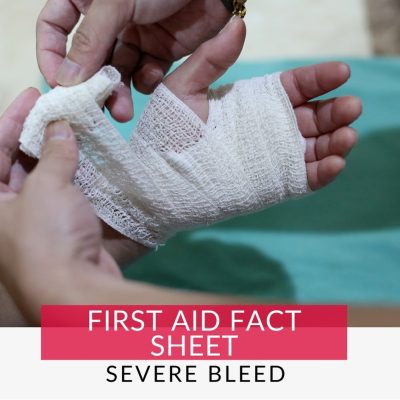
Severe Bleeding First Aid Management: Important First Aid Steps for managing and controlling Severe Bleeding
Bleeding should be managed as severe and life-threatening if it cannot be controlled by firm, direct and continuous pressure, and/or there are signs of shock. Follow these steps for severe bleeding first aid management.
If it is obvious that severe and life-threatening bleeding is present, controlling bleeding before the Airway and Breathing can be lifesaving. Send for help early by calling triple zero (000) for an ambulance.
Signs & Symptoms:
As well as the obvious sign of blood coming from a wound, signs and symptoms of severe bleeding include:
- weak, rapid pulse
- pale, cool, moist skin
- pallor, sweating rapid, gasping breathing
- restlessness
- nausea
- thirst
- faintness, dizziness or confusion
- loss of consciousness.
Examples of life threatening and severe bleeding include the following situations:
- an amputated or partially amputated limb above the wrist or ankle
- shark attack, propeller cuts
- or similar major trauma to any part of the body.
What to do – Severe Bleeding First Aid:
- Follow DRSABCD.
- Apply gloves if available. Help the patient to lie down. Remove or cut the patient’s clothing to expose the wound.
- Apply firm, direct and continuous pressure on the bleeding wound initially with your hands until the bleeding stops. The patient or a bystander can do this.
- When available, apply a pad or dressing in or directly over the wound and apply firm, direct and continuous pressure until the bleeding stops. If an object is embedded in or protruding from a wound, apply pressure on either side of the wound and place pads around the object before bandaging.
- Once bleeding is controlled secure the pad by bandaging firmly, ensuring the pad remains directly over the wound. Observe for any further bleeding.
- Continue to check the patient’s vital signs (consciousness, breathing and pulse) and look for recurrence of bleeding. Do not give the patient anything to eat or drink.
- If the bleeding is not controlled and: The bleeding is on a limb, apply an arterial tourniquet (if available) and tightened until the bleeding stops. Advise the patient that this will cause pain. The bleeding is not on a limb, remove existing dressings and apply a hemostatic dressing (if available) in or directly over the wound and apply firm, direct and continuous pressure until the bleeding stops.
- Call Triple Zero (000) for an ambulance.
In a medical emergency call Triple Zero (000). You could save a life with First Aid Training